
135 Chip and Hardware Stocks Are Down 25% or More. Seven Are High-Quality Businesses.
We took every US chip and hardware stock trading 25% or more below its 52-week high and kept the ones that score well on business quality and against their peers. 135 names became seven, and most of the seven are still priced above our estimate of value.
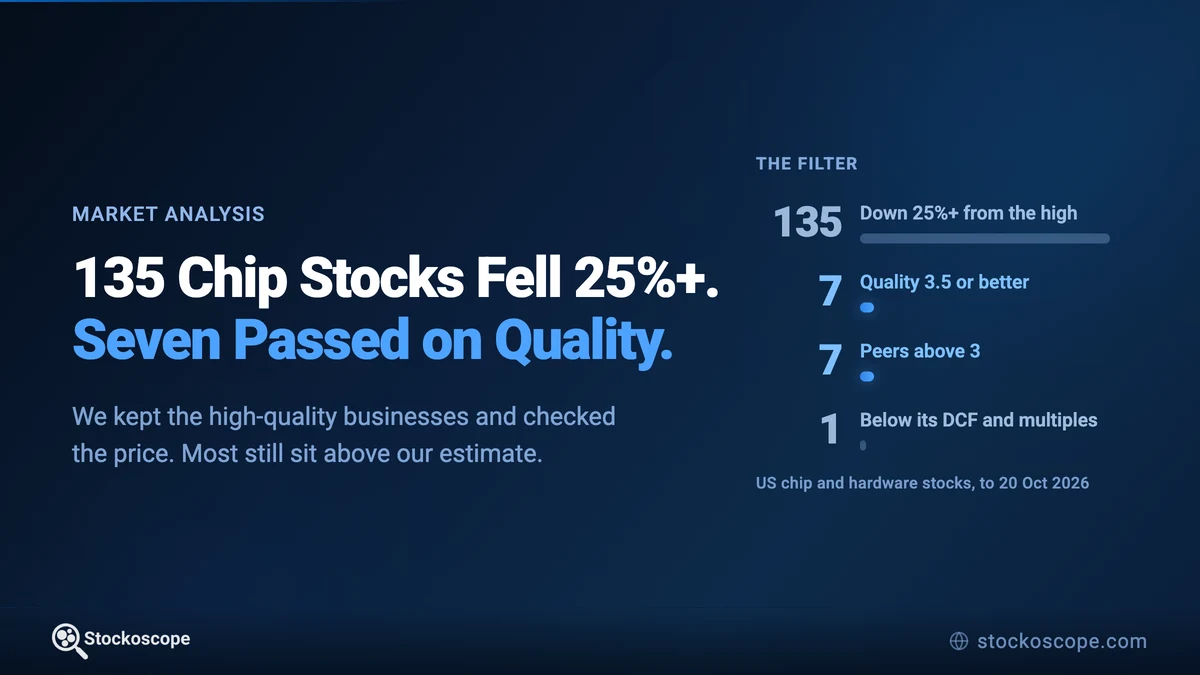
AI stocks have had a rough few months. Among US chip and hardware stocks, the companies the AI build-out buys from, 135 of 176 now trade at least 25% below their 52-week high, and the typical one has lost almost half its value. Nvidia, the name most people think of first, is only 10% off its high. The damage is further down the chain.
A fall that wide usually takes some good businesses down with the weak ones, so we went looking for them. We kept only the stocks that score well on business quality and against their peers, and 135 became seven. Then we checked what those seven cost. Only Micron trades well below our estimate of value. Broadcom is about in line with it, and the other five are still priced above it, two of them at double or more, even after falls of 26% to 46%.
What has been weighing on AI stocks
Most of these stocks peaked in May or June. The worries since then have mostly been about the future, because this year's results have mostly been strong.
In mid-September Anthropic's chief executive published an essay arguing that AI development should slow down, and OpenAI said it wouldn't list this year. On the next trading day chip and data-centre stocks fell while most of the big cloud companies rose. Vertiv lost 7.7%, Applied Materials 7.1% and Micron 5.3%, while Alphabet gained 3.2%.
October added more. A hot inflation report revived talk of rate rises, which makes the debt-funded data-centre build-out more expensive. China's CXMT said it would bring out a server memory chip, and memory makers fell on fears of a glut later in the decade. Then Broadcom's chief executive, Hock Tan, said access to capital could become a bigger limit on AI than chip supply, and warned that some investors were treating AI like a casino. By 16 October the Philadelphia semiconductor index had fallen eight sessions in a row, its longest losing run since 2008.
Step 1: chip and hardware stocks down 25% or more
So that anyone can repeat this and get the same list, we fixed the group by industry before looking at any results. We took every US stock on Stockoscope in four industries: Semiconductors; Computer Hardware; Hardware, Equipment & Parts; and Communication Equipment. Between them they cover the chips, memory, networking and servers that AI data centres are built from. The industry is the one shown on each stock's page, and we didn't add or remove any stock by hand.
The rule leaves some AI names out. AI cloud companies such as CoreWeave, the firms that build and power data centres, and AI software companies all sit in industries that are mostly made up of businesses with nothing to do with AI. Adding those industries would have turned this into a different list.
176 stocks are in the four industries, and 135 of them closed on 20 October at least 25% below their highest close of the past year. The median one is down 46%, and 95 of the 135 peaked in May or June 2026.
| Industry | Stocks | Down 25%+ | Median fall | Median Quality | Quality 3.5+ |
|---|---|---|---|---|---|
| Semiconductors | 80 | 69 | -46% | 2.04 | 6 |
| Communication Equipment | 30 | 26 | -44% | 1.87 | 1 |
| Hardware, Equipment & Parts | 43 | 27 | -46% | 2.39 | 0 |
| Computer Hardware | 23 | 13 | -57% | 1.85 | 0 |
| All four | 176 | 135 | -46% | 2.08 | 7 |
The median fall and median Quality are for the stocks down 25% or more.
The biggest names mostly didn't make the list. Besides Nvidia, AMD and Cisco are 18% off their highs and Marvell 24%.
Step 2: Quality of 3.5 or better
Our Quality score rates a business on up to ten years of annual results. It uses 40 measures in ten groups, covering growth in sales and profit, margins, returns on capital, how much profit turns into cash, debt and interest cover, and per-share growth, among others. Each measure is scored against fixed bars and the results are combined into one score from 1 to 5. It moves slowly on purpose, because a decade of results doesn't change on one good quarter. The average US stock scores 2.49, and only about 1 in 20 reaches 3.5.
One of the 135, Quantinuum, doesn't have a Quality score yet because it listed recently. Of the other 134, seven score 3.5 or better.
What got cut follows a clear pattern. The further a stock fell, the weaker the business tended to be. Fifty-four stocks are down 50% or more. The 53 of them with a score have a median Quality of 1.83, and none of them passes. The quantum computing companies, which sit in Computer Hardware, score among the lowest: IonQ is at 1.87 and Rigetti at 1.83. Cerebras, the AI chipmaker that listed in May, is at 2.27.
Step 3: Peers above 3
Quality judges a company against fixed bars. Peers takes the same 40 measures over the latest twelve months and ranks them against companies of the same sector and size, so Micron is compared with 143 large US tech companies. It's also scored 1 to 5, and a 3 is the middle of the pack. Above 3 means the business is ahead of most of its peers right now.
We expected this step to cut a few more names, but all seven score above 3. The strong long-term records hold up against current competitors too.
The seven
| Company | Ticker | What it does | Below 52-week high | 12-month change | Quality | Peers |
|---|---|---|---|---|---|---|
| KLA | KLAC | Inspection tools for chipmakers | -46% | +40% | 3.70 | 3.3 |
| Micron | MU | Memory chips, including AI memory | -26% | +333% | 3.67 | 4.4 |
| Broadcom | AVGO | Custom AI chips and networking | -31% | -4% | 3.66 | 3.9 |
| Ubiquiti | UI | Networking gear for businesses and internet providers | -44% | -18% | 3.63 | 3.7 |
| Rambus | RMBS | Memory-interface chips for servers | -46% | -6% | 3.59 | 3.5 |
| Applied Materials | AMAT | Chipmaking equipment | -44% | +78% | 3.57 | 3.3 |
| Monolithic Power | MPWR | Power chips, including for AI servers | -26% | +21% | 3.52 | 3.2 |
Look at the 12-month column before anything else. Four of the seven are higher than they were a year ago, Micron by 333%. A stock can be well off its high and still up on the year.
What each one costs
For valuation we use the estimate shown on each stock's Valuation page. Half of it comes from a discounted cash flow model, and half from what the market pays for similar earnings, judged against the company's peers or its own history. Below we say how far the price sits above or below that estimate, and give the P/E against the company's own ten-year median as a simpler check.
Micron: the one below our estimate
Micron makes memory chips, including the high-bandwidth memory that sits beside AI processors. It's down 26% from its June high, and the falls came in steps. SK Hynix, its biggest rival in AI memory, listed in New York in July. Then in October CXMT said it would make server memory, and talk turned to too much memory being built for the years ahead.
The business has never looked stronger. Revenue for the year to early September was $133 billion, up from $37 billion the year before, at an 81% gross margin. At $896 the shares trade on 11.9 times trailing earnings, close to their ten-year median of 12.7. Our estimate is $1,415, which puts the price 37% below it.
The catch is that memory is a cyclical business, and this estimate is built on record earnings. If CXMT and new factories push memory prices back toward normal, those earnings shrink and the gap closes from the other side. That is the risk the market is pricing. Micron's next report, due in December, will be the first test.
Broadcom: in line with our estimate
Broadcom designs custom AI chips for a handful of the largest cloud companies, and sells the networking chips that link them together. It's 31% below its June high, and much of the latest drop followed Hock Tan's comments about capital. When a few customers buy most of your AI chips, their ability to fund data centres decides your revenue.
At $334 the price is in line with our estimate of $354. The DCF on its own comes out higher, at $503, and the market comparisons come out lower. Its P/E of 41.5 is a little under its own ten-year median of 44.9.
Rambus and Monolithic Power: above our estimate
Rambus sells the chips that manage the traffic between a server's processor and its memory. It's down 46% from its high, even though its June-quarter revenue was a record $207 million, up 20% on a year earlier. Its P/E of 41.6 is close to its ten-year median of 42.9, yet the price is 39% above our estimate of $67, mainly because the DCF comes out lower.
Monolithic Power makes power-management chips, including the ones that feed AI servers. It's 26% off its high and still up 21% on the year. At 76 times earnings it sits above its own long-run P/E of 70, and the price is 128% above our estimate of $547. That's the widest gap of the seven.
KLA and Applied Materials: well above our estimate
These two make the machines chipmakers depend on. Applied builds equipment that deposits and etches material on wafers, and KLA makes the inspection tools that catch defects. KLA is down 46% from its June high and Applied 44%. KLA reports on 28 October.
Even after those falls, both trade at about twice their own ten-year median P/E: KLA at 43.9 against 22.0, and Applied at 34.7 against 18.1. Applied's price is 75% above our estimate of $231, and KLA's is 100% above our estimate of $81. Both are still up on the year, Applied by 78%.
Ubiquiti: in the list because of its industry
Ubiquiti makes networking equipment, mostly Wi-Fi, switches and cameras for businesses, plus wireless gear for internet providers. It isn't an AI company in the way the others are. It's here because it sits in Communication Equipment, and a fixed rule means taking what the rule gives.
Its fall started earlier than the rest, from an April high. The shares lost 42% in May after a March quarter in which cash dropped from $437 million to $176 million, as it repaid $250 million of bonds and kept buying back shares, and it gave no guidance. It had also added a "memory surcharge" to some products, citing swings in memory prices, the same tight memory market that has lifted Micron's margins. The June quarter was strong, with revenue up 23% to $937 million.
At 38 times earnings against a ten-year median of 31, the price is 49% above our estimate of $407.
Three near misses
Lam Research (3.48), Photronics (3.46) and M-tron Industries (3.40) just missed the Quality cut, and all three pass on Peers. Lam's price is 130% above our estimate and M-tron's 49% above. Photronics, which makes the photomasks used to print chip designs onto wafers, is 26% below.
What the filter shows
Most of the selloff landed on weaker businesses: 92 of the 134 scored stocks rate below 2.5 on Quality, and none of the 54 stocks down 50% or more passes. The seven strong ones still fell hard, a median 44%, but four of them had risen so far beforehand that they're still up on the year, and the fall leaves most of them priced above our estimate. Micron is the exception, and its estimate rests on earnings that may be close to the top of a cycle.
For most of these seven, the debate is about price. KLA's report on 28 October and Micron's in December will move these numbers. Every score and estimate here is on each stock's page on Stockoscope if you want to look at the detail behind it.
How we did it
- The group: every US stock on Stockoscope whose industry, as shown on its stock page, is Semiconductors; Computer Hardware; Hardware, Equipment & Parts; or Communication Equipment. Industry labels come from our data provider, Financial Modeling Prep. No stock was added or removed by hand. Bel Fuse's two share classes count separately.
- The fall: the 20 October 2026 close at least 25% below the highest close from 20 October 2025 to 20 October 2026. These are closing prices, so the high can sit below the intraday high.
- The filters: Quality of 3.5 or above, then Peers (the sector comparison) above 3. Scores are as of 21 October 2026.
- The estimate of value is the blended estimate on each stock's Valuation page. "In line" means within 20% of the price.
The 135 stocks, by industry
Semiconductors (69): BZAI -95%, ALMU -76%, WATT -75%, ATOM -75%, TRT -75%, NVTS -73%, MRAM -70%, INDI -70%, GSIT -69%, WOLF -68%, IPWR -67%, AEVA -65%, UCTT -64%, ICHR -62%, CBRS -62%, QUIK -61%, AXTI -60%, AIP -59%, GCTS -59%, INVE -58%, AEHR -57%, LASR -57%, AOSL -57%, ACMR -57%, VSH -56%, AMKR -55%, IPGP -53%, OUST -53%, ALGM -51%, PLAB -48%, GFS -48%, KLAC -46%, KOPN -46%, VECO -46%, POWI -46%, RMBS -46%, SITM -45%, AMAT -44%, AMBQ -44%, ON -44%, CRDO -43%, ASYS -43%, MXL -43%, CEVA -42%, ONTO -42%, ACLS -41%, ALAB -41%, KLIC -40%, LRCX -39%, CRUS -38%, MTSI -36%, INTC -35%, AMBA -34%, FORM -33%, Q -33%, SMTC -31%, LSCC -31%, PENG -31%, AVGO -31%, DIOD -30%, TER -30%, QCOM -30%, INTT -29%, COHU -29%, NXPI -29%, PI -27%, MCHP -26%, MU -26%, MPWR -26%
Communication Equipment (26): INSG -79%, AMPG -73%, VISN -71%, ADTN -66%, AAOI -66%, ONDS -57%, OCC -51%, CALX -47%, AIRG -46%, KVHI -46%, CIEN -46%, GNSS -45%, UI -44%, CLFD -43%, VIAV -37%, ARLO -36%, HLIT -35%, EXTR -34%, NTGR -34%, VSAT -33%, LTRX -31%, BKTI -31%, BDC -30%, FEIM -28%, AVNW -28%, LITE -27%
Hardware, Equipment & Parts (27): SLNH -85%, CPSH -70%, VPG -59%, LPTH -59%, WRAP -57%, TTMI -57%, MKSI -53%, FN -52%, UMAC -52%, GLW -48%, VICR -46%, FLEX -46%, OLED -46%, COHR -46%, BELFA -41%, SANM -40%, ITRI -39%, AEIS -38%, OSIS -37%, BELFB -36%, MPTI -33%, DAKT -32%, ESE -30%, BHE -29%, JBL -28%, MEI -27%, TRMB -26%
Computer Hardware (13): RGTI -74%, OSS -70%, UAVS -69%, QBTS -68%, QUBT -62%, QNT -57%, IONQ -57%, INFQ -56%, WDC -51%, QMCO -45%, SNDK -42%, SMCI -41%, STX -38%
All data, prices and scores reflect information available at the time of writing (October 2026).
This analysis is for educational purposes only and does not constitute financial advice. Our scores and estimates are model outputs that move with their assumptions, and they do not account for your personal circumstances. Do your own research before making any investment decisions.