
Intuit Is Down 60% While Earnings Rose 20%. What Is the Price Assuming?
TurboTax is losing customers on price, and the market has marked Intuit down as if AI is about to take the whole company apart. TurboTax is a quarter of the revenue. We went through the 10-K, and through the comments on our Reddit post, where small-business owners and accountants told us about QuickBooks.
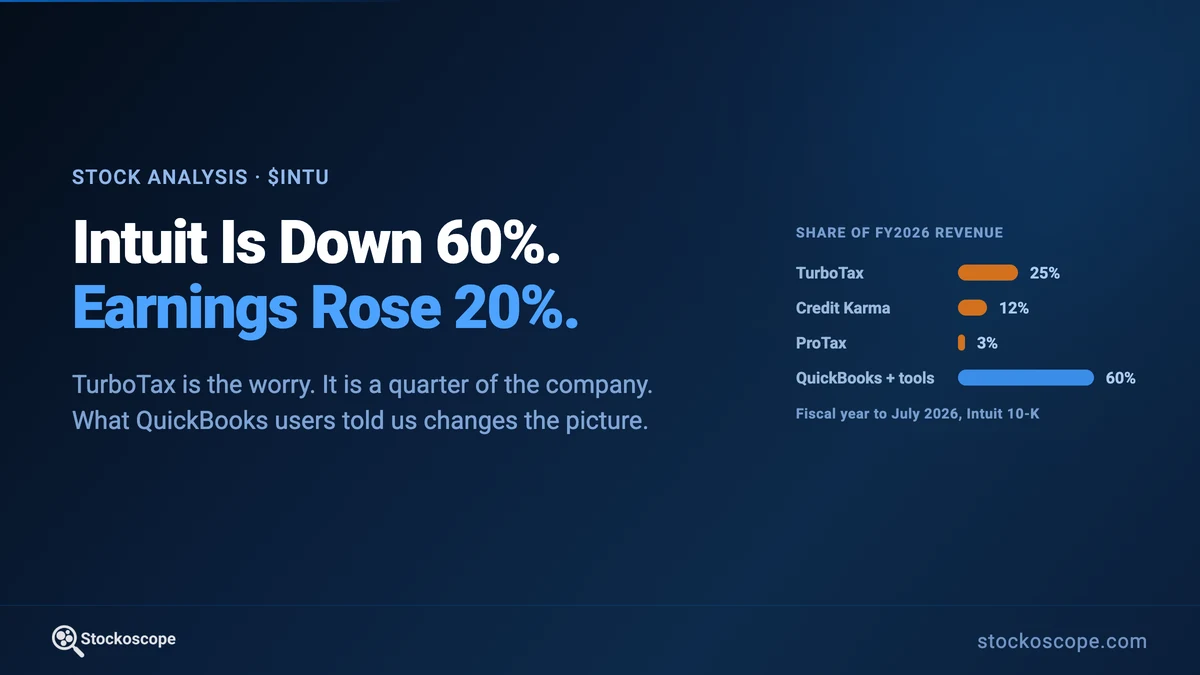
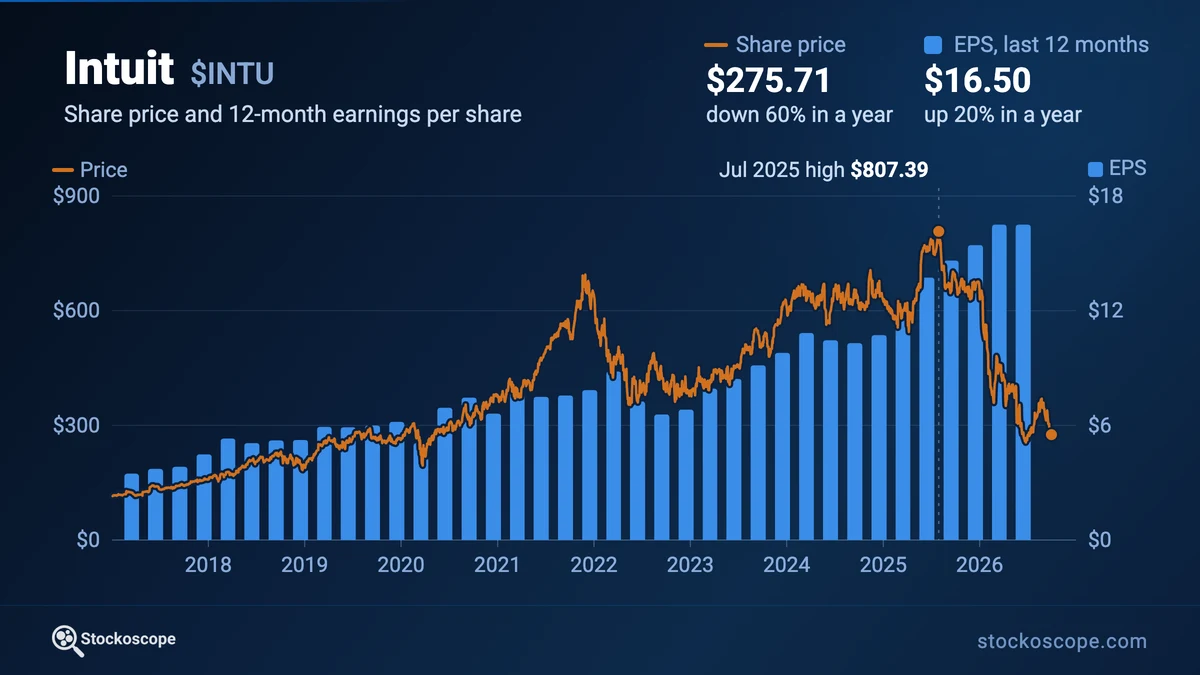
Intuit closed at $275.71 on 30 September, down 60% in a year and 66% from its July 2025 high of $807.39. Over the same twelve months its earnings per share rose 20%.
Intuit makes TurboTax, the tax-filing software used for 39 million US returns this year. The worry is AI. If a chatbot can do a simple return for little or nothing, why pay TurboTax? And Intuit's own management has given the bears their best line. On the fourth-quarter call in August, the CEO said the company "lost quality DIY customers to lower-cost providers this year" and that "price is now the number one reason customers leave TurboTax."
So the price and the business have gone in opposite directions for a year, and the company itself has confirmed part of the story. We ran Intuit through the framework in the usual order: what the business is, how good it has been, how it compares with its peers, and what the price assumes. Then we added something new. A shorter version of this analysis on r/ValueInvesting drew 148 comments, including small-business owners and accountants who use QuickBooks, and they changed our view of the part of Intuit we thought was safe.
What Intuit actually sells
Intuit reports two segments, but it publishes revenue for six businesses, and the split matters more than anything else in this post.
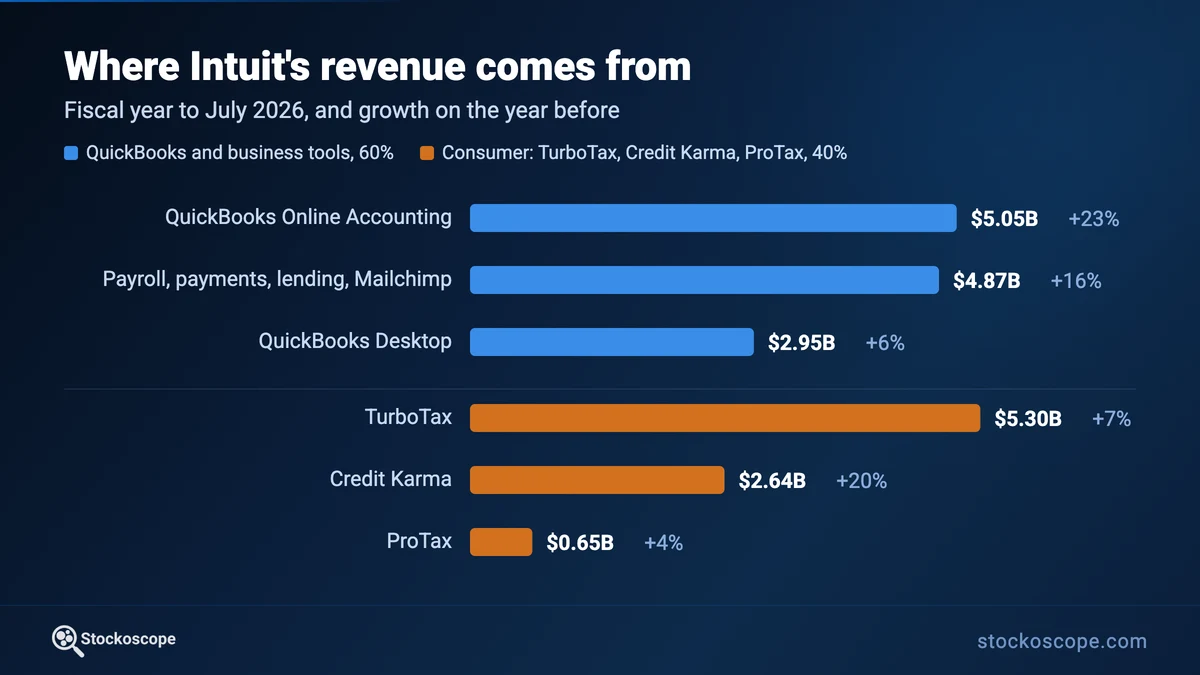
Table 1. Revenue by business, fiscal year to July 2026
| Business | What it is | Revenue | Growth |
|---|---|---|---|
| QuickBooks Online Accounting | Small-business accounting | $5.05B | +23% |
| Online services | Payroll, payments, lending, Mailchimp | $4.87B | +16% |
| QuickBooks Desktop | The installed version | $2.95B | +6% |
| TurboTax | Personal tax filing | $5.30B | +7% |
| Credit Karma | Credit-score app, paid per loan or card | $2.64B | +20% |
| ProTax | Tax software for accountants | $0.65B | +4% |
| Total | $21.45B | +14% |
Credit Karma gets paid when its members take out a loan, card or insurance policy through the app, and Intuit is moving QuickBooks Desktop customers onto the online version.
TurboTax is 25% of revenue. QuickBooks and the services sold around it are about 60%, and even without Mailchimp, which Intuit will report separately from this year, QuickBooks is more than half the company.
Inside TurboTax the picture is worse than the 7% suggests. Federal returns filed through it fell from 39.9 million to 39.0 million, with desktop down 7% and online down 2%. Revenue only grew because TurboTax Live, where a human expert does or checks the return, grew 37% and now makes up 53% of TurboTax revenue. On our arithmetic from those two figures, everything else in TurboTax, mostly the do-it-yourself software, shrank by roughly 14%. That is the part AI competes with most directly.
Management's response is to compete on price. Intuit says it is "deliberately accepting lower initial DIY tax ARPC", meaning less revenue per do-it-yourself customer in their first year, to win filers back. Guidance for fiscal 2027 has TurboTax growing 2% to 3%, and the company as a whole 9% to 10%, down from 14%.
How good has the business been?
Quality is the ten-year view, so one bad tax season can't dominate it. Intuit's record has two halves.
Table 2. Ten years of results, fiscal 2017 to 2026
| FY2017 | FY2020 | FY2022 | FY2024 | FY2026 | |
|---|---|---|---|---|---|
| Revenue | $5.20B | $7.68B | $12.73B | $16.29B | $21.45B |
| Operating margin | 27.3% | 28.3% | 20.2% | 22.3% | 27.4% |
| Return on invested capital | 46.2% | 20.6% | 8.5% | 12.0% | 16.8% |
| Diluted shares | 261M | 264M | 284M | 284M | 277M |
| Stock-based pay | $0.33B | $0.44B | $1.31B | $1.94B | $2.06B |
Revenue has grown about 16% a year for a decade, from $4.7 billion in fiscal 2016, and the operating margin is back where it was before 2020. That is the strong half.
The weak half is what Intuit paid for some of that growth. It bought Credit Karma in December 2020, for about $3.4 billion in cash plus stock and awards worth $4.7 billion, and Mailchimp in November 2021, for about $5.7 billion in cash plus 10.1 million shares worth $6.3 billion. Goodwill went from $1.7 billion to $13.7 billion in two years. Return on invested capital, in the high 30s before 2020, bottomed at 8.5% in fiscal 2022. It has climbed back to 16.8%, which is respectable for most companies and still less than half of what Intuit earned before the deals.
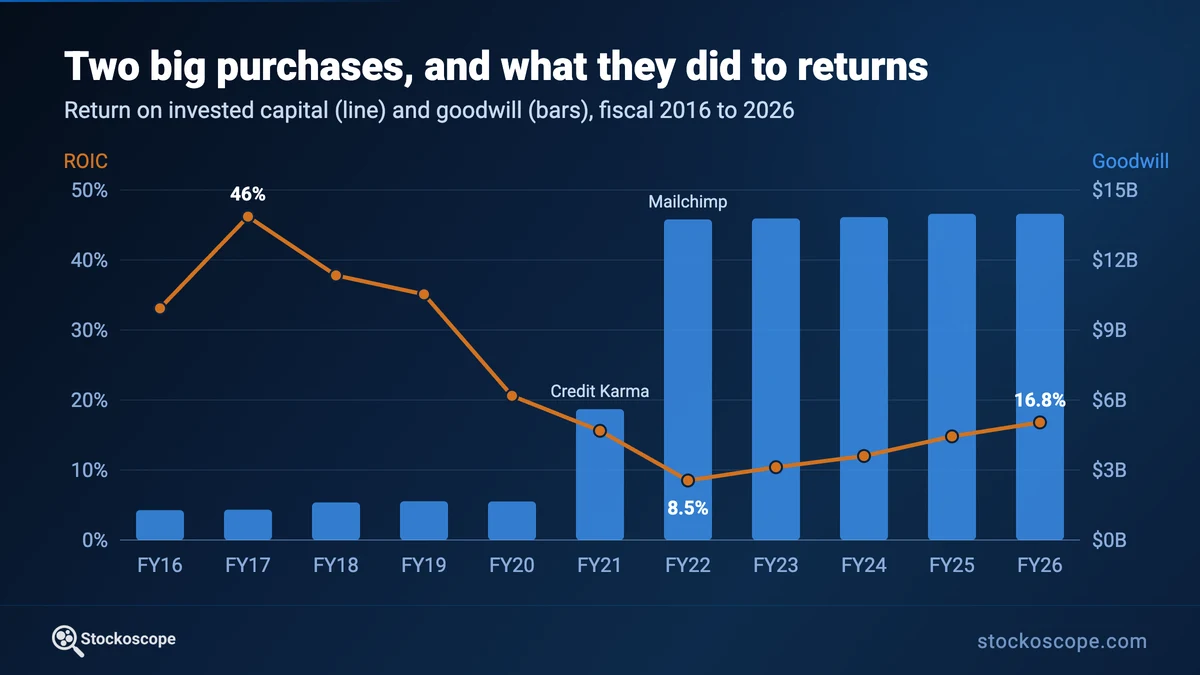
Credit Karma has earned its place: revenue grew 20% last year. Mailchimp has not. Intuit's guidance for it this year is about $1.26 billion and flat to down 1%, for a business it paid about $12 billion for.
The share count tells the same story. Intuit spent about $17 billion on buybacks over the ten years, and there are still 6% more diluted shares than in fiscal 2017, because the two deals were paid partly in stock and stock-based pay rose from $0.3 billion to $2.1 billion a year. Our Quality score for Intuit is 3.77 out of 5: high margins and strong cash conversion, held back by returns on capital that never recovered from the acquisitions.
How does it compare with its peers?
Peers are compared on the last twelve months. Against the 33 US large-cap application-software companies, Intuit is in the top quarter on cash flow (85th percentile) and returns (77th), above average on margins (70th), and middle of the pack on growth (47th).
Table 3. Intuit against well-known software peers, last twelve months
| Revenue growth | Operating margin | Return on invested capital | |
|---|---|---|---|
| Intuit | 13.9% | 28.8% | 16.8% |
| Adobe | 12.0% | 35.7% | 36.8% |
| Autodesk | 17.9% | 27.6% | 21.2% |
| Salesforce | 11.2% | 21.4% | 8.7% |
| ServiceNow | 22.2% | 11.4% | 5.5% |
| Workday | 13.4% | 12.0% | 11.4% |
Same data source for all six, which is why Intuit's operating margin here is a little above the 10-K figure in Table 2.
Intuit is a better operator than most of software and grows like an average one. Adobe, the other name the market has filed under "AI loser", earns more on its capital at a similar growth rate.
What does the price assume?
On every multiple we track, Intuit is priced at between a quarter and a third of its own ten-year median.
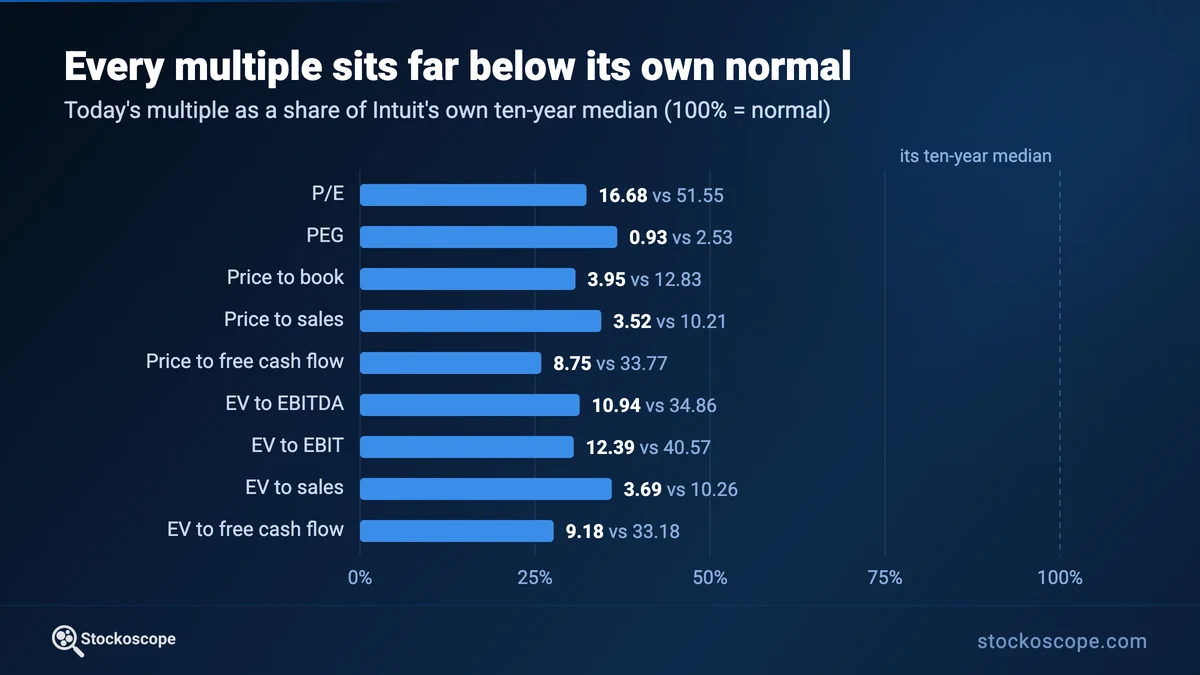
The P/E is 16.7 against a ten-year median of 51.6 and a technology-sector median of 37.9. Price to free cash flow looks even cheaper at 8.7, but that figure is flattered, for a reason we come to below.
Stockoscope's DCF, using analyst revenue growth of about 10% a year tapering after year five and a 9.1% discount rate, puts Intuit at $535. That number on its own is less useful than how it splits. The next ten years of cash flow are worth about $191 a share, and everything after year ten adds about $344. At $276, the market is paying for the next decade and about a quarter of what comes after it. The AI worry is exactly a worry about what comes after.
The simplest test we found is to take TurboTax out completely. What's left, QuickBooks, Credit Karma and ProTax, made $16.2 billion last year, up 16%, faster than Intuit as a whole. The whole company's enterprise value is about 4.9 times those sales, against a ten-year median of 10.3 times sales for Intuit.
There are two catches. Credit Karma leans on TurboTax: Intuit says customers who use both bring in about twice the revenue, and Credit Karma members filing through TurboTax grew by more than half. Losing TurboTax would take some of Credit Karma with it. And Intuit doesn't report TurboTax's profit on its own, because the tax experts, much of the marketing and the R&D sit in corporate costs. If TurboTax earns the company's average 27% operating margin, removing it leaves the rest at about 18 times operating profit. If it earns the 73% margin the Consumer segment shows before corporate costs, which is a pessimistic ceiling, the rest is at about 40 times. The truth is somewhere in between.
The cash, with the one-offs taken out
Free cash flow jumped 42% to $8.6 billion, which is what makes the price-to-cash-flow multiple look so low. Two adjustments bring it back to earth.
Cash taxes fell from $1.41 billion to $0.28 billion, because the 2025 tax law let Intuit expense R&D immediately again, including a catch-up on earlier years. Put last year's tax bill back and free cash flow is $7.5 billion, up 23%. Then stock-based pay: $2.06 billion, or 9.6% of revenue. Intuit itself stopped excluding it from its adjusted earnings in August. Take it out and you get about $5.4 billion, roughly 14 times the $76 billion market value. Still cheap against Intuit's history, and a long way from 8.7.
What QuickBooks users told us
When we posted a shorter version of this on Reddit, the bear case on TurboTax barely needed defending. People described filing with ChatGPT or Claude plus FreeTaxUSA, and others pointed out that an AI won't be much help in an IRS audit. Both are happening.
The surprise was QuickBooks. We had called it the safe half. The most upvoted comment agreed, from someone who uses it daily and sees AI as a boost to it. But a lot of small-business owners and accountants said the opposite:
- An accountant whose firm has 80% of its clients on QuickBooks Online said most of them only put up with it because they have to, and that the price goes up every year.
- Another commenter made the sharpest version of the argument. QuickBooks' real edge was that every accountant knew it and every answer was a search away. If AI can answer the same questions for Xero or Wave, that edge goes.
- Several had just switched, or were planning to.
People have complained about QuickBooks prices for years while revenue kept growing, so we went back to the fourth-quarter call to see whether the numbers back them up. They partly do.
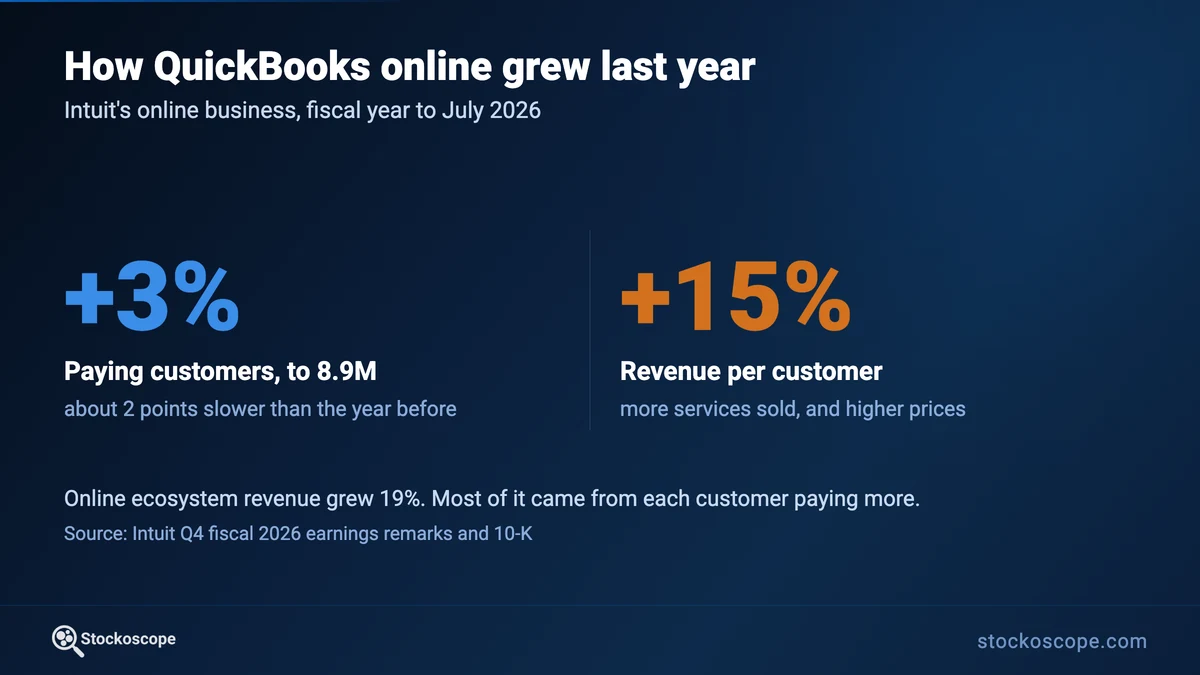
Online paying customers grew 3% last year to 8.9 million, about two points slower than the year before. Revenue per customer grew 15%, which Intuit puts down to selling more services, especially to bigger businesses, "as well as value-based pricing". So most of QuickBooks' growth came from existing customers paying more. Management knows it. On the call they said "we need to grow new customers at a faster pace", and they are launching QuickBooks Free and QuickBooks Lite to bring new businesses in.
That is the same sequence TurboTax went through: years of raising prices and upgrading customers, slowing customer growth, then a move to cheaper entry plans. QuickBooks is a step or two behind. The revenue is still growing at 23%, and the higher-end products for mid-sized businesses grew 39%. But the customer count is the number that turned first at TurboTax, and at QuickBooks it is slowing.
Analysts and holders
Analysts followed the price down, as they usually do. The median price target was $837.50 a year ago and is $380 now. Big funds were split before the last leg down: in the June quarter, 998 institutions added to their holdings and 1,267 reduced them. A reader who tracks long-horizon managers made the same point on Reddit, that the quality-growth crowd was already divided three months ago. Insiders show no unusual selling. None of this tells you much the price doesn't.
Our take
The price treats TurboTax as a business in decline and QuickBooks as next. On the reported numbers, the first is under way and the second has not happened. But after reading what QuickBooks users had to say, we'd put it less comfortably than we did on Reddit. QuickBooks is growing more on price than on new customers, and that is how the TurboTax problem started.
At about 4.9 times sales for everything except TurboTax, a lot of bad news is already in the price, and we think Intuit is priced for a worse outcome than it has reported so far. Three numbers will tell us whether that holds:
- TurboTax returns filed next tax season, the first with the cheaper entry pricing.
- QuickBooks online paying customers, 8.9 million and growing 3%. If that goes to zero, the worry covers the whole company.
- Revenue per online customer. If the free and lite plans pull it down sharply, QuickBooks revenue growth will follow.
A multiple a third of its normal can stay there for years. That is not the same as safe.
This article is research and education, not investment advice. Figures are from Intuit's fiscal 2026 10-K, its fourth-quarter release and prepared remarks of 25 August 2026, the 8-K filings for the Credit Karma and Mailchimp acquisitions, and Stockoscope's data as of the 30 September 2026 close.