
Anthropic's IPO: What the Numbers Say
Anthropic is reportedly aiming to list at up to $2 trillion. Its filing shows extraordinary growth, a giant loss that isn't what it looks like, and bills that run to 2045. Do the numbers back the hype? We put it through the ten questions we ask of any stock.
Anthropic filed to go public on 26 October. It plans to list on Nasdaq as ANT, reportedly aiming for Thanksgiving week at between $1.5 and $2 trillion. At the top of that range it would be worth more than SpaceX, which listed at $1.77 trillion in June.
The filing is the first proper look outsiders have had at its accounts. We put it through the ten questions we ask of any stock. They cover growth, dilution, profit, use of assets, returns, cash, bills, debt, price and what shareholders get back. Together they help you judge how good the business is, and what its price assumes.
Normally we'd answer them with ten years of numbers. Anthropic has three and a half, and a couple of the questions don't really fit a company this young. Where that's the case, we say so. Everything below comes from the filing unless it's linked to another source, and at the end we give our own read. None of it is a recommendation.
1. Is the business growing?
Yes, and at a speed that's hard to put in context.
Table 1. Anthropic's revenue by year.
| Period | Revenue | Growth |
|---|---|---|
| 2023 | $41M | |
| 2024 | $386M | 9x |
| 2025 | $4.6B | 12x |
| First half of 2026 | $16.3B | 14x the first half of 2025 |
Q2 2026 revenue was $11.6 billion, nearly 15 times the same quarter a year earlier. The filing doesn't report the September quarter, but it says Q3 revenue was 86 times that of the last quarter of 2024, which was $197 million. That puts Q3 at roughly $17 billion, up a little under 50% on Q2.
That's slower than the first half of the year, but Anthropic's growth has come in waves. A cheaper, more capable model launched in November 2025, and growth went from about 48% that quarter to 132% and 144% in the next two. Q3 is back near the late-2025 pace. Another new model came out in September, so the December quarter will show whether a new wave has started.
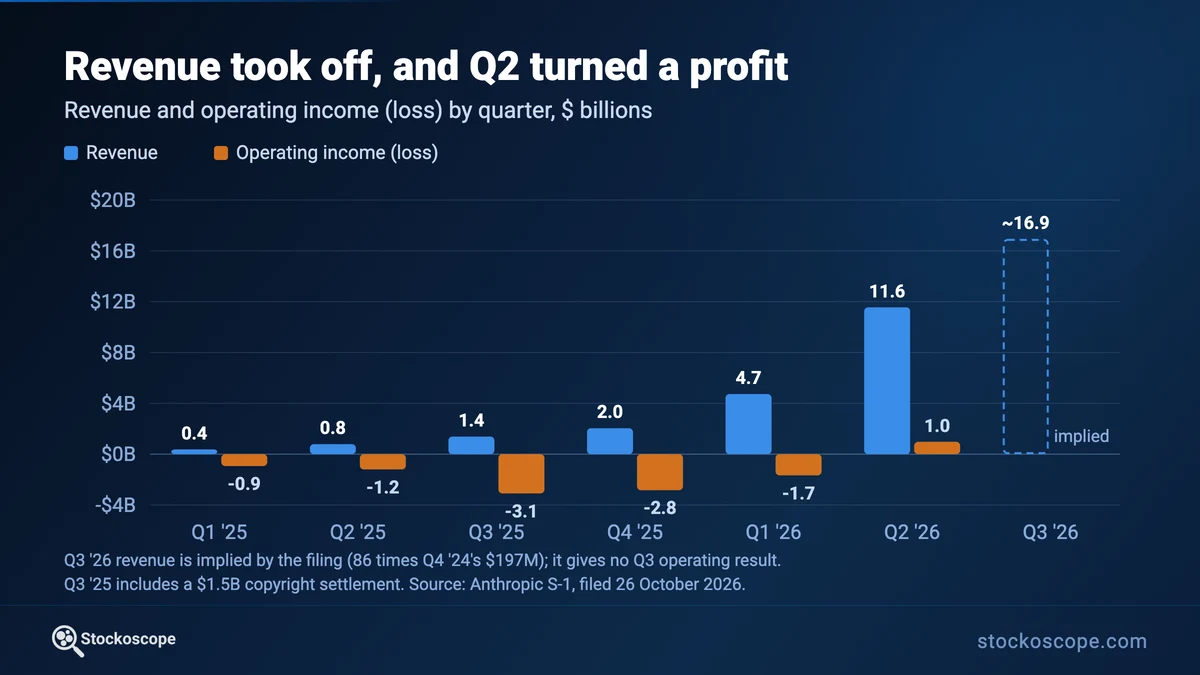
Figure 1. Revenue more than doubled in each of the first two quarters of 2026, and Q2 was the first with an operating profit. The filing implies Q3 grew a little under 50%.
The growth is broad. Customers paying $100,000 or more a year went from about 20 at the end of 2023 to more than 11,900 by September 2026. Existing customers keep spending more: Anthropic puts its net revenue retention at about 900%, meaning customers who were paying a year ago now pay around nine times as much in total. That's Anthropic's own measure, which no outside auditor has checked, and it leaves out people on its fixed-price Claude Pro and Max plans.
Big customers still matter a lot. The five biggest paid about a quarter of all revenue in the nine months to September, though their share fell from 36% in Q1 to 21% in Q3, and no single customer passed 10%. Many can cut back whenever they like: at the end of June, customers had committed to only $10.8 billion of spending they couldn't cancel, less than one quarter's revenue. And 48% of first-half revenue came through the cloud marketplaces of Amazon, Google and Microsoft, which are also Anthropic's investors, suppliers and competitors.
The filing lists plenty that could slow growth, from customers breaking its usage rules (an estimated 5% to 7% of revenue this year) to richer rivals, falling prices, its own safety delays, export curbs and an unresolved fight with the Pentagon. It expects growth to slow, possibly sharply.
So where could revenue be in two or three years? Nobody knows, Anthropic included, but simple arithmetic shows how much rides on the answer. Start from Q3's pace (its revenue times four), about $68 billion a year, and apply three growth rates, all well below today's.
Table 2. Anthropic's yearly revenue pace (a quarter's revenue times four) at three growth rates, starting from Q3 2026. Our arithmetic, not a forecast.
| If revenue... | September 2027 | September 2028 | September 2029 |
|---|---|---|---|
| Doubles every year | $136B | $271B | $542B |
| Grows 50% a year | $102B | $152B | $229B |
| Grows 20% a year | $81B | $98B | $117B |
The growth is real and broad, but it comes in waves and little of it is locked in. Question 9 shows which of these rows the price needs.
2. Are shareholders getting richer per share?
This question is about dilution. A company can double its revenue, but if it also doubles its share count, each share owns no more than before.
Counting investors' preferred shares as the ordinary shares they'll become, Anthropic's share count rose about 2.7 times from the end of 2024 to June 2026, to roughly 10.7 billion. Revenue grew far faster, from $386 million in 2024 to $19.7 billion in the 12 months to June, so revenue per share is up roughly 19 times. Each funding round was also priced well above the last, so existing holders came out well ahead.
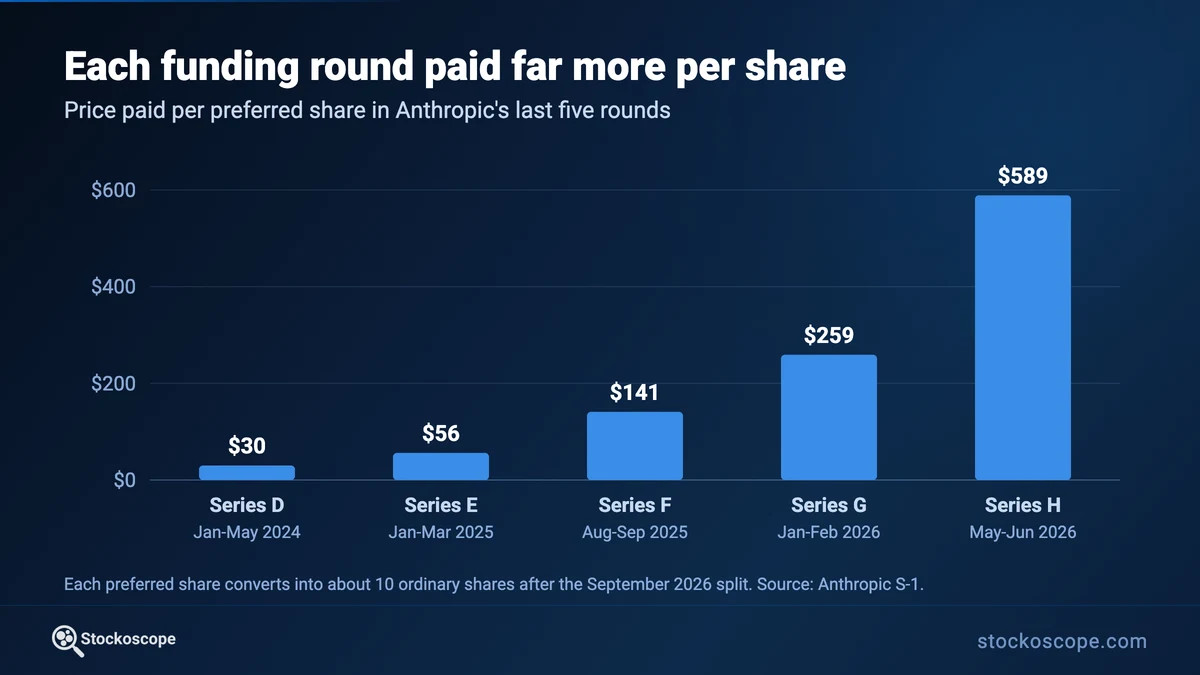
Figure 2. Investors paid $30 a preferred share in early 2024 and $589 in mid-2026.
There's a lot more dilution to come. The filing's fully diluted count was about 16.9 billion shares at the end of June, nearly 60% more than the 10.7 billion above. Most of the gap is shares promised to staff and Amazon's convertible notes, both explained in question 3. More will come from top-ups to its charity fund and from funding deals with Google, Amazon, AMD and Broadcom. Some existing holders can also sell sooner than the usual six months after an IPO.
So far the answer is yes: early holders have done very well per share. Anyone buying at the IPO starts from a far higher price, with many more shares already lined up.
3. Is it efficient at making a profit?
For any company we look at three margins. Gross margin is what's left of each revenue dollar after the direct cost of serving customers. Operating margin is what's left after every cost of running the business, including research and sales. Net margin is the bottom line, after interest, tax and anything else. Figure 3 shows where Anthropic's revenue went for the first two.
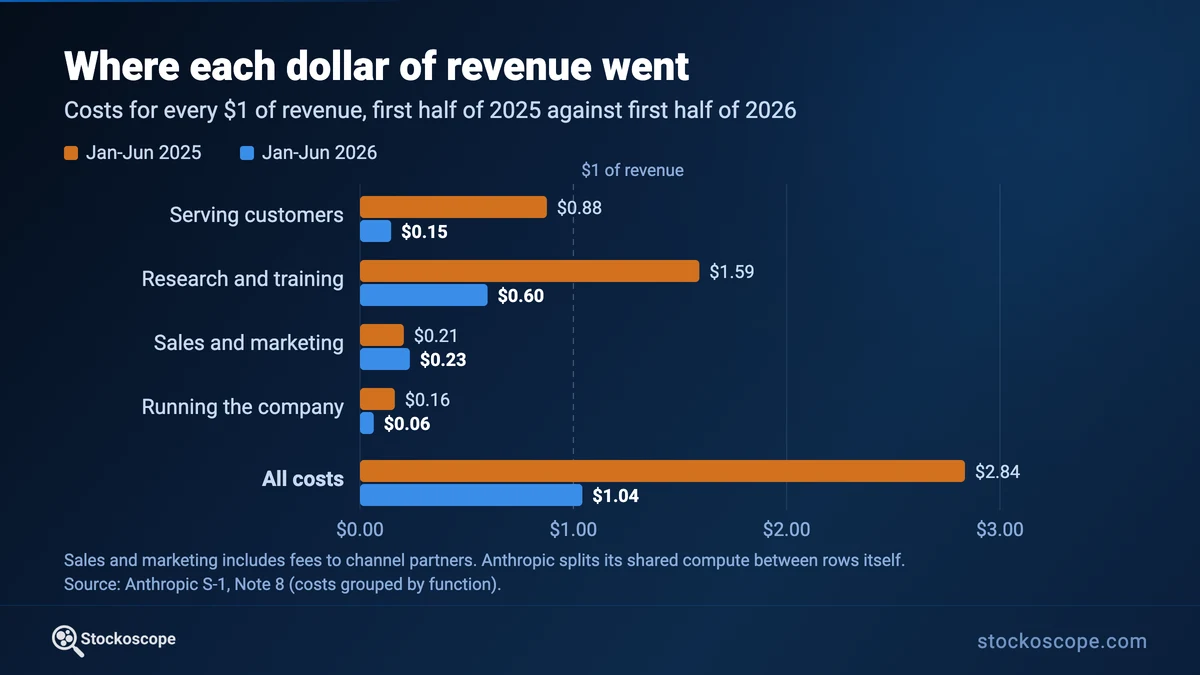
Figure 3. A year ago Anthropic spent $2.84 for every dollar of revenue. Now it spends $1.04, and serving customers takes 15 cents of it.
Gross margin: serving customers cost 15 cents of each revenue dollar in the first half of 2026, a gross margin of 85%. That's up from 12% a year earlier and 40% for 2025 as a whole, and more like a software company than one that rents huge amounts of computing power. It's the pattern you'd expect from an AI lab: running today's models makes good money, and building tomorrow's is what costs it.
Two things flatter that 85%, though. Anthropic books the full price of cloud-marketplace sales as revenue and puts the cloud companies' cut under sales and marketing. Fees paid to channel partners were $2.7 billion higher than a year before. Count even that increase as a cost of serving customers and the margin falls to about 69%. And because research and customers share one pool of chips, how that cost is split between them is Anthropic's own call. Across everything, computing power took 55 cents of every revenue dollar.
Operating margin: add research, sales and running the company, and costs came to $1.04 for every revenue dollar. That's an operating margin of -4% for the first half, a loss of $693 million. Research and training is the biggest cost, at 60 cents, much of it computing power for training new models. The trend is good, though. In Q2 the margin turned positive for the first time: an operating profit of $974 million, or 8% of revenue.
Share pay will push it back down first. Q2's profit already counts $1.3 billion of stock-based pay, but most of what staff are owed in shares isn't counted yet. Their restricted stock units (RSUs), shares promised to staff, only become theirs once the company lists, so that's when the cost appears. On June's figures, listing adds $26.6 billion of costs, $2.9 billion at once and the rest over about two years. That's roughly $2.8 billion a quarter, nearly three times Q2's operating profit. New computing power could too: Anthropic warns it may squeeze margins, because its cost lands before the revenue it brings.
Net margin is where the headline $80.7 billion loss shows up: a net margin of about -500%. Almost none of it comes from running the business.
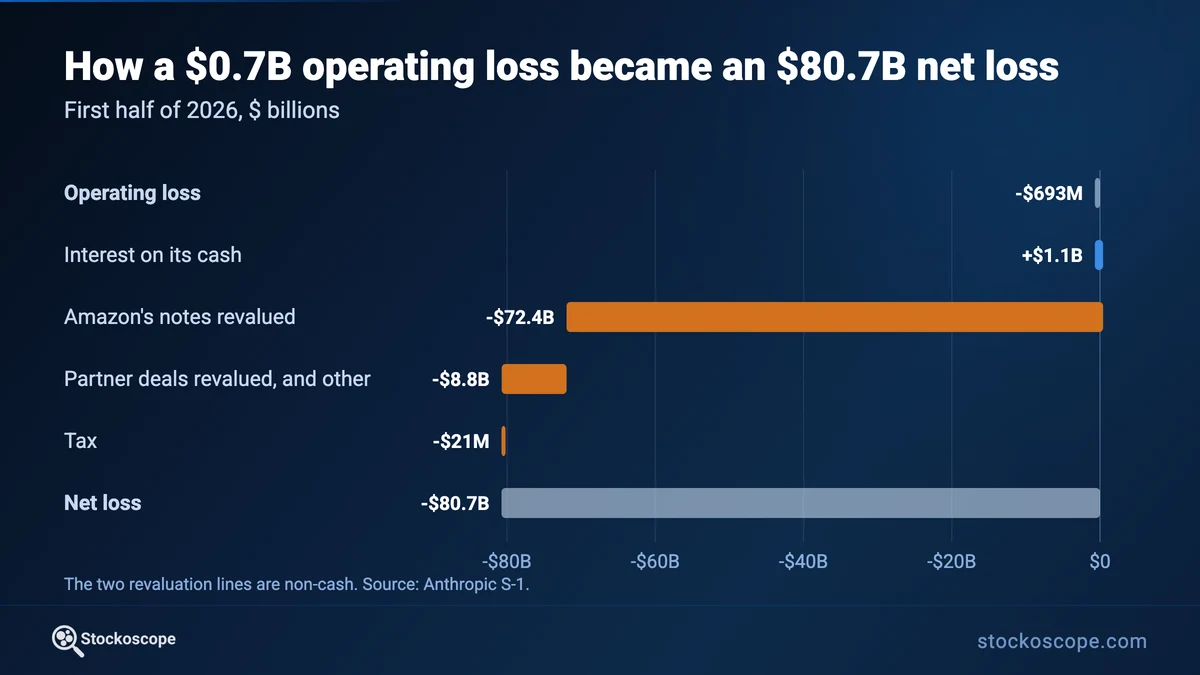
Figure 4. The two revaluation lines add up to $81 billion, more than the whole loss. Interest on its cash more than covers the operating loss.
Most of it traces back to a loan. In 2023 and 2024 Amazon lent Anthropic money through convertible notes, loans that turn into shares at a fixed price: $2.09 and $5.05 a share, against about $59 an ordinary share in the latest round. As Anthropic's value rose, the notes became worth far more to Amazon, and accounting rules make Anthropic book that rise as a loss: $72.4 billion in the first half. Another $8.8 billion is mostly the same kind of revaluation on newer partner deals. No cash changed hands in either. Leave them out and the first half shows a profit of about $400 million, a net margin of about 2%.
Serving customers pays well, and the business as a whole has just tipped into an operating profit. Whether it stays there depends on revenue growing faster than the share-pay bill and the cost of new chips.
4. Does it use its assets wisely?
Normally we'd look at how long a company waits to get paid and how much it ties up in equipment. Customers owed Anthropic $5.8 billion at the end of June, about 46 days of Q2 revenue, a normal wait for a company that sells to businesses. It owns very little: $1.2 billion of property and equipment, while cash and short-term investments make up 89% of its $147 billion of assets. Until now cloud providers have owned the chips and Anthropic has rented the computing power.
That's changing. It's starting to lease chips directly, expects capital spending to rise significantly, and by June had signed about $321 billion of leases that hadn't started yet (question 8).
For now it gets paid quickly and runs light. Within a year, this answer will look very different.
5. Does it generate good returns?
This is the one that doesn't fit yet. Return on equity and return on invested capital, which measure profit against the money put into the business, need a few years of steady profit, and Anthropic has one profitable quarter. Its equity is even negative on paper, at -$127.6 billion, because investors' preferred shares ($157.5 billion) and Amazon's notes sit outside equity until they convert at the IPO, so any return figure built on it would mean nothing.
Each dollar it spends is producing more, though. In Q2, revenue was nearly 15 times a year earlier while compute costs were four times, and revenue per employee over the past year was $6.6 million, up from $1.4 million. Good signs, but not yet a return on capital.
6. Does it generate real cash?
Profit on paper and cash in the bank aren't the same thing, so we check the cash flow.
Table 3. Cash from operations, capital spending and free cash flow.
| Period | Cash from operations | Capital spending | Free cash flow |
|---|---|---|---|
| 2023 | -$1.63B | -$2M | -$1.63B |
| 2024 | -$5.69B | -$15M | -$5.71B |
| 2025 | -$2.64B | -$131M | -$2.77B |
| First half of 2026 | +$3.93B | -$482M | +$3.45B |
The first half of 2026 is the first period in the filing where the business brought in more cash than it spent. About $1.2 billion of that was timing, such as using up computing power paid for in earlier years and owing suppliers more, and $1.1 billion was interest on its cash. Strip both out and the business made roughly $1.65 billion of cash on its own.
Capital spending of $482 million is small, and won't stay that way. As it pays up front for its own data centres, Anthropic expects "significant net cash used in operating and investing activities for the foreseeable future".
The business has just started to pay its own way, but building will take far more cash than it brings in for years.
7. Can it pay its bills?
Yes. At the end of June it had $138 billion of cash and other assets it could turn into cash within a year, against $7.2 billion of bills due in that time. Our usual bar is 1.5 times; Anthropic's is 19 times. Most of that is the $111 billion it raised in the first half, and in September it enlarged its credit line to $15 billion.
That covers the next 12 months, Anthropic says. Further out, it expects to raise more through share sales, borrowing and partner financing, possibly sooner than planned.
It can pay its short-term bills many times over. The long-term ones are another matter: next to the $431 billion of compute it can't cancel (question 8), even its $132 billion of cash and short-term investments doesn't go far.
8. Is the debt level safe?
The balance sheet shows $117.5 billion of liabilities, but $108.6 billion of that is Amazon's convertible notes, which are meant to turn into shares, not be repaid. Nothing was drawn on its credit line at the end of June. In the usual sense, it has almost no debt.
The real obligation is the computing power Anthropic has agreed to buy. Four deals it can't cancel, with Amazon, Google, Microsoft and Broadcom, come to about $431 billion. Adding up everything in the filing's notes gives roughly $850 billion (our sum, not the filing's), with more on top that depends on how much capacity arrives. The bills stretch out to 2045.
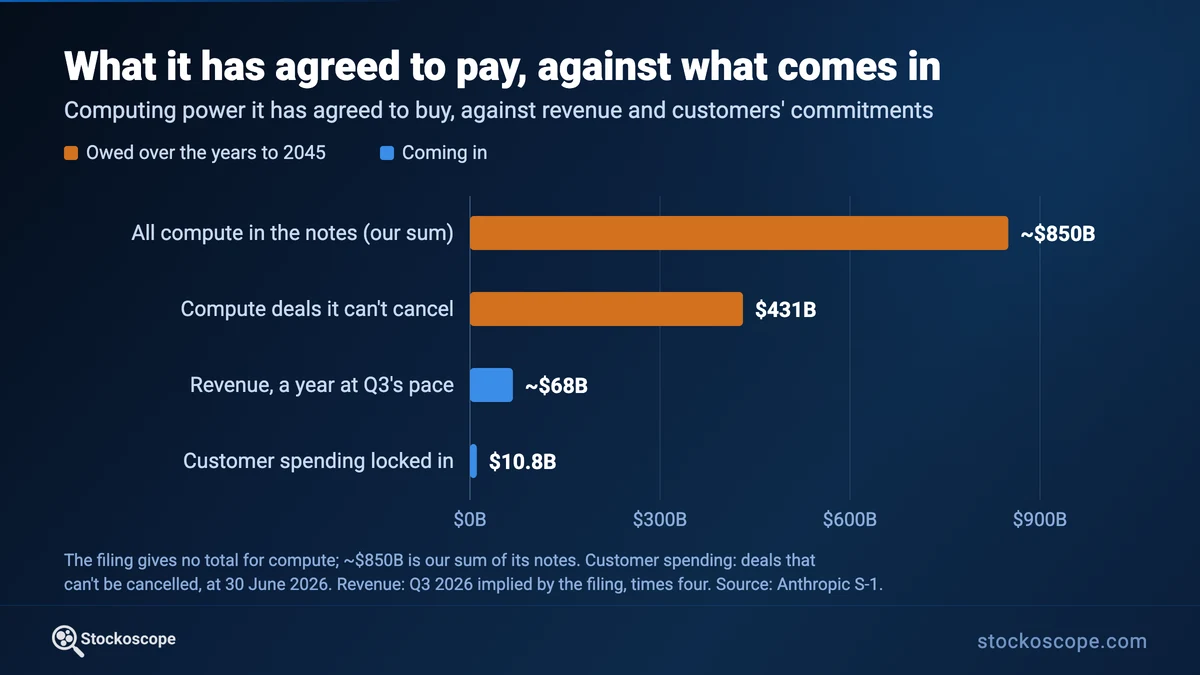
Figure 5. The compute deals it can't cancel come to more than six years of revenue at Q3's pace.
It's a bet that revenue keeps climbing for years, and the filing is blunt about the downside: Anthropic might not be able to pay, and defaulting on some contracts could set off defaults on its credit line and notes. There are also copyright suits from book authors and music publishers, which the filing puts no figure on.
The risk here isn't debt; it's the compute bills, which work only if revenue keeps growing strongly for years.
9. Is the price reasonable?
We'd normally value a company on the cash it should make in future (a discounted cash flow model), but you can't do that sensibly on one profitable quarter. The usual yardstick for a company like this is price to sales: its value divided by its revenue.
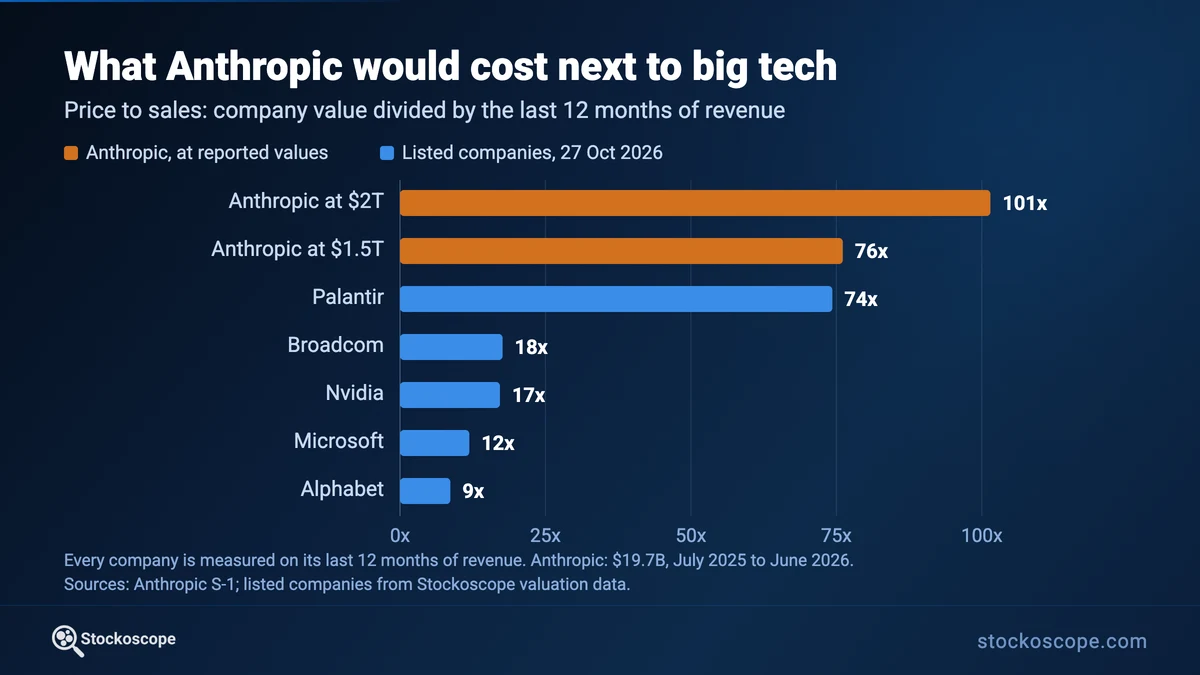
Figure 6. On the last 12 months of revenue, Anthropic at $1.5 trillion would cost about what Palantir does. At $2 trillion it would cost more.
The last 12 months is a harsh measure for a company growing this fast, because it includes quarters when revenue was a fraction of today's. On Q3's pace of about $68 billion a year, the multiples are 22 times at $1.5 trillion and 30 times at $2 trillion. A year from now, on the rows of Table 2, they'd be 11 to 18 times at $1.5 trillion and 15 to 25 times at $2 trillion. Those forward figures can't be set against the chart, which uses the last 12 months for every company.
Price to sales ignores profit, so here's another way: ask what the price assumes. Microsoft trades at about 30 times its yearly profit. If Anthropic one day earned a 30% profit margin and traded on that multiple, here's the revenue it would need to be worth each price.
Table 4. What the reported valuations would need, at 30 times earnings and a 30% profit margin.
| Valuation | Yearly profit | Revenue needed | Times Q3's pace | Years away at 50% a year |
|---|---|---|---|---|
| $1.5T | $50B | $167B | 2.5x | Just over 2 |
| $2T | $67B | $222B | 3.3x | About 3 |
Again, that's arithmetic, not a forecast. Even at 50% a year, revenue takes two to three years to get there, and the margin has to rise from Q2's 8% operating margin to 30% after tax, with the RSU costs on top. If both happened, Anthropic would be worth $1.5 to $2 trillion two to three years from now: roughly the price being talked about today, before the extra shares in question 2. Doubling every year would get there in under two years. At 20% a year, it would take five years or more.
In short, the price already counts on several more years of very fast growth and a big jump in profit margins.
10. Does it reward shareholders?
No dividends, and just one small share buyback, $157 million in 2025. That's normal for a company growing this fast: the cash is worth more in the business. What's less normal is how much it gives away and how little say shareholders get.
It gives shares away. Besides the 5% of its shares held by its own charity fund, the Public Benefit Fund, it matches employees' charitable donations with shares, which cost $541 million in 2025 and $2.0 billion for August 2026's donations alone. Every share given away is a cost to the other shareholders. All seven co-founders have also pledged 80% of their stakes to charity. The pledges are revocable, and as the founders give shares away their economic stake shrinks while their voting control stays put, which the filing says could pull their interests apart from other shareholders'.
Public shareholders will have almost no say. The co-founders will hold a single share carrying 50.1% of the vote, with no fixed end date, and an independent trust of five people picks a majority of the board.
It's also a public benefit corporation, so by law its directors weigh its mission alongside shareholders' financial interests. It has refused to let its models be used for mass surveillance, and chose not to build image and video generators so its chips go to research and safety. It says choices like these may not maximise shareholder value. That may help it win customers who care about safety, but it can also cap returns.
The bigger point for shareholders is control: buyers get a share of the profits, but very little say in how they're made.
What to watch
The amended filing, due before the shares are sold, should add the price range, how many shares are on offer and who is selling them, the September quarter's results, and the total compute commitment, including how much falls due by the end of 2030. Three things will matter most: whether Q3 growth really was a little under 50%, and whether the December quarter picks up after September's new model; the operating margin once the RSU costs start; and the full compute bill against revenue.
Our take
Do the numbers back the hype? For the business, largely yes. In three years Anthropic has gone from almost no revenue to a pace of about $68 billion a year. It turned an operating profit in Q2, the first half brought in more cash than it spent, and the $80.7 billion loss is almost all accounting.
The price is another matter. At $1.5 to $2 trillion, buyers would be paying today for two to three more years of 50% growth and a 30% after-tax margin, against Q2's 8% operating margin, before $26.6 billion of share pay starts to land. Behind that sit hundreds of billions of dollars of computing bills that are due whether or not the revenue comes, more shares on the way, and almost no say in how the company is run.
Our read: this is an exceptional business, priced for the next few years to go right. If growth keeps coming in waves, as it did after the November 2025 model launch, the revenue the price assumes is within reach. If Q3's slowdown is the start of a trend, there's little room for error, and the filing itself expects growth to slow.
The ten answers in one place
Table 5. The ten questions, answered from the S-1. The marks are our own short read of each answer, not a score.
| Question | Our mark | What the filing says |
|---|---|---|
| 1. Is it growing? | Strong, in waves | Extremely fast: $16.3B of first-half revenue, against $1.2B a year earlier. Q3 grew a little under 50%, back near its late-2025 pace. |
| 2. Are shareholders richer per share? | Strong so far | So far, yes. Revenue per share is up about 19 times since 2024, but full dilution adds nearly 60% more shares. |
| 3. Is it efficient at making a profit? | Mixed | An 85% gross margin on Anthropic's split (about 69% counting partner fees) and a first operating profit in Q2, before $26.6B of RSU costs that start at the IPO. The $80.7B net loss is mostly on paper. |
| 4. Does it use its assets well? | Good for now | Paid in about 46 days, and owns little hardware. That's changing, with $321B of leases signed. |
| 5. Does it earn good returns? | Too early | One profitable quarter, and equity is negative on paper until the IPO. |
| 6. Does it make real cash? | Mixed | $3.9B from operations in the first half, more than half of it from timing and interest. It expects heavy outflows as it builds. |
| 7. Can it pay its bills? | Strong | Easily for now, with $132B in cash and investments, but it expects to raise more. |
| 8. Is the debt safe? | Risky | Its main "debt" turns into shares. The real obligation is about $431B of compute it can't cancel, against about $68B a year of revenue. |
| 9. Is the price reasonable? | Priced for strong growth | At $1.5T, 76 times its last 12 months' revenue, about where Palantir trades, or 22 times Q3's pace. It needs years of fast growth and much higher margins to grow into. |
| 10. Does it reward shareholders? | Weak | No dividends, almost no say for public shareholders, and it gives shares to charity. Its mission can come before returns. |
Figures are from Anthropic's S-1 filed with the SEC on 26 October 2026, unless linked to another source. Growth scenarios and valuation arithmetic are ours. Listed-company multiples are from Stockoscope's valuation data as of 27 October 2026.