
Six Hyped Stocks We Never Posted About, and What Would Change Our Minds
Nebius, IREN, Rocket Lab, AST SpaceMobile, CoreWeave and Cerebras were named in nearly 1.7 million posts on X in a year. We never posted about any of them. Here's why, and what would change our minds.
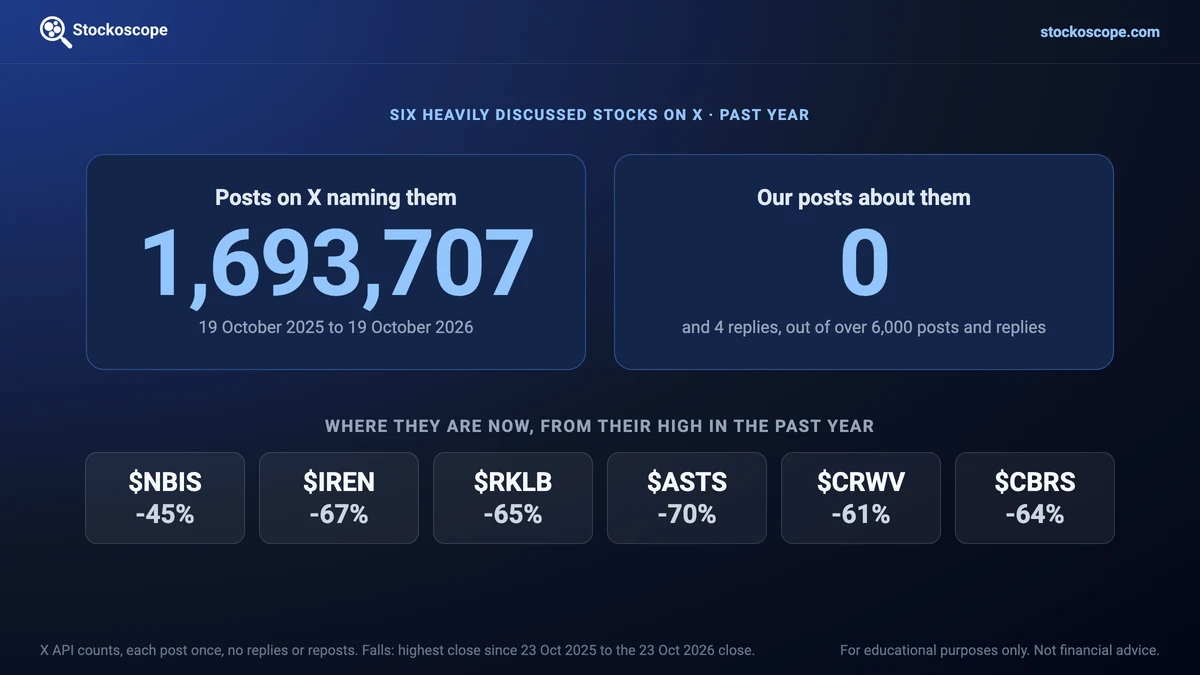
In the year to 19 October, Nebius (NBIS), IREN (IREN), Rocket Lab (RKLB), AST SpaceMobile (ASTS), CoreWeave (CRWV) and Cerebras (CBRS) were named in nearly 1.7 million posts on X, not counting replies or reposts. We didn't write a single post about any of them in that year, on X or on Reddit.
We didn't see the falls coming, and we never said they would fall. All six are now 45% to 70% below their highest close of the past year, but that isn't why we left them alone. The story was there. The profits weren't.
Over the past week we explained on X, one stock a day, what kept each one off our feed and what would change our minds. This post puts the six in one place.
What we look for before we post about a stock
Two questions come first. Is it a good business: does it make a profit, does cash come in faster than it goes out, and can it carry its debt? And is the price reasonable for what the business has already shown?
We look ahead as well as back. Our valuation also prices each stock on analysts' forecasts for next year, so expected growth counts. Even on those forecasts, Nebius loses money through at least 2027, and CoreWeave and AST SpaceMobile don't make a profit before 2028.
A stock that passes the first question and fails the second can still be worth watching. All six of these fail the first, and most of them fail the second too.
Where they stand
| Company | Ticker | Below 52-week high | 12-month change | Quality | Peers | Valuation | Analysts | Holdings |
|---|---|---|---|---|---|---|---|---|
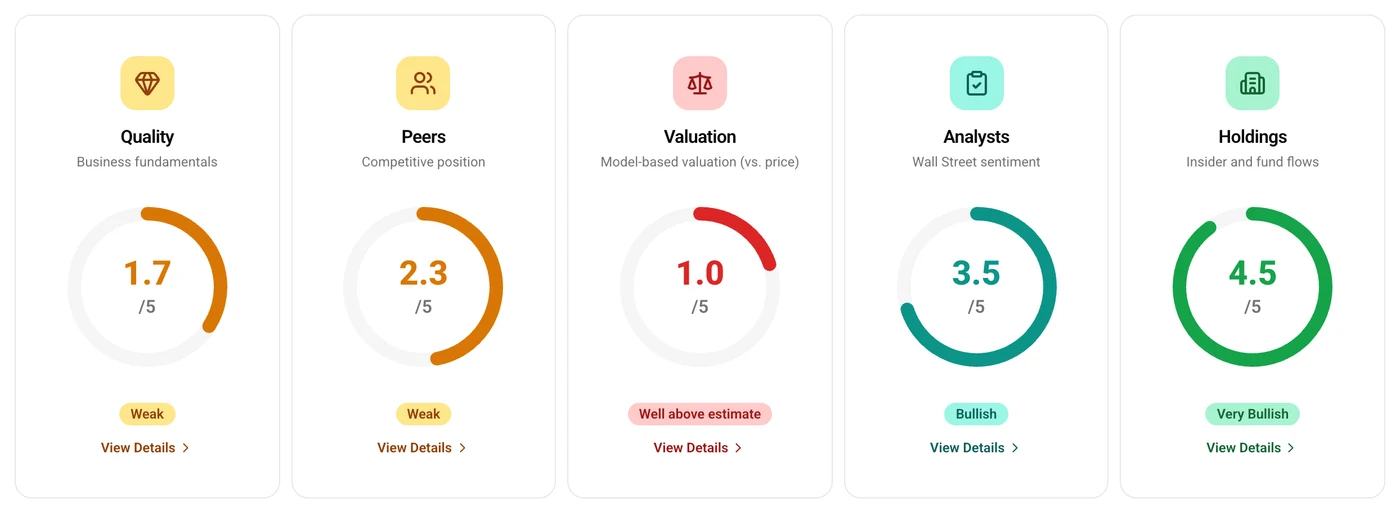
| Nebius | NBIS | -45% | +50% | 1.7 | 2.3 | 1.0 | 3.5 | 4.5 |
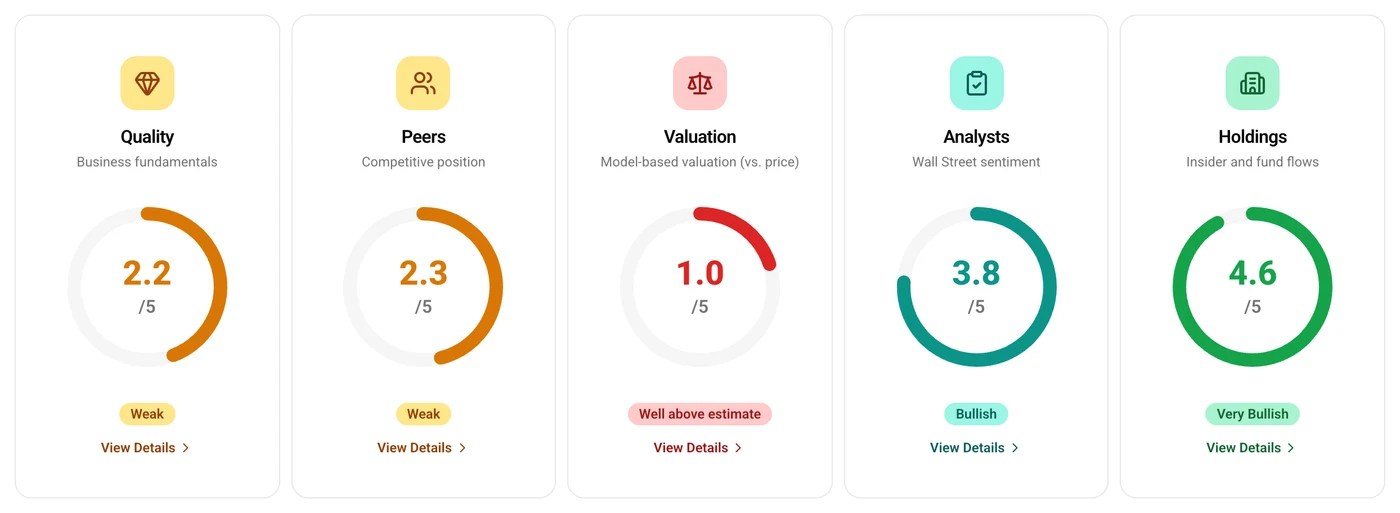
| IREN | IREN | -67% | -55% | 2.2 | 2.3 | 1.0 | 3.8 | 4.6 |
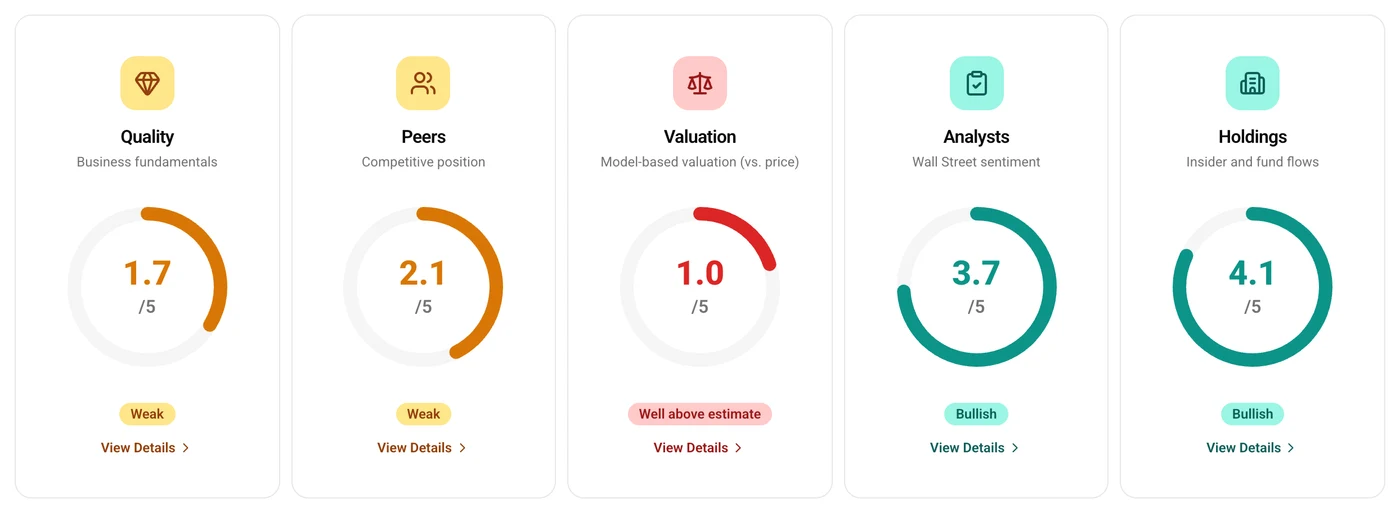
| Rocket Lab | RKLB | -65% | -17% | 1.7 | 2.1 | 1.0 | 3.7 | 4.1 |
| AST SpaceMobile | ASTS | -70% | -45% | 1.8 | 1.4 | no score | 3.0 | 4.6 |
| CoreWeave | CRWV | -61% | -56% | 1.9 | 2.1 | no score | 3.9 | 4.1 |
| Cerebras | CBRS | -64% | listed in May | 2.3 | 1.8 | 1.0 | 3.9 | 4.0 |
Prices are 23 October closes. Scores are out of 5. On Quality and Peers a 3 is the middle, and a Valuation of 1.0 means the price is well above our estimate of value.
Two things stand out. First, Nebius is up 50% on a year ago, so this isn't a list of losing trades for everyone who owned them.
Second, the five lenses split down the middle. Quality and Peers look at the business itself, and all six score low on both. Analysts and Holdings look at what Wall Street and the big funds think, and they're positive on nearly all six: five of the six rate Bullish with analysts, and big institutions kept adding to all six through June, Cerebras since its May listing. When the business numbers and the market's mood disagree, we go with the business numbers.
The six, in short
Nebius (NBIS)
Nebius rents out AI computing power from data centres it builds or rents. The growth is real: quarterly sales rose from $105 million to $582 million in a year, and Microsoft and Meta have both signed multi-year deals worth billions.
The cost of that growth is the problem. In the last year it spent $11.1 billion on data centres and chips against $1.4 billion of sales, lost $669 million at the operating line and burned $5.9 billion of free cash flow. Debt and leases went from $1.2 billion to $10.1 billion. Analysts expect losses through at least 2027.
What would change our mind: an operating profit, and proof that the spending earns a return. Its losses are already shrinking as a share of sales, from 106% a year ago to 30% in the June quarter, so this one could get there.
IREN (IREN)
IREN started as a bitcoin miner and is turning its data centres over to AI cloud. Quarterly sales fell from $240 million to $137 million over three quarters, as mining shrank faster than AI cloud grew, and operating losses widened every quarter. Debt and leases went from $1.0 billion to $7.8 billion in a year.
The other side is big. Microsoft signed a $9.7 billion, five-year contract with a 20% prepayment, and analysts expect sales of about $2.7 billion in the year to June 2027, roughly four times the year before. Most of the June-quarter loss was a write-down of old mining machines.
What would change our mind: the AI revenue showing up in the reported numbers, then a profit.
Rocket Lab (RKLB)
Rocket Lab launches small satellites and builds spacecraft and their parts. Sales grew 62% in a year and its backlog of orders more than doubled to $2.4 billion.
It still loses about $58 million a quarter at the operating line, the same as a year ago. In August and September it sold $1.94 billion of new shares, mainly to help pay for buying Iridium, and each new share makes every existing share a smaller piece of the company. Neutron, its bigger rocket, has slipped to 2027. At more than 40 times sales, the price only works if almost everything goes right.
What would change our mind: a profit, and a price that leaves room for delays.
AST SpaceMobile (ASTS)
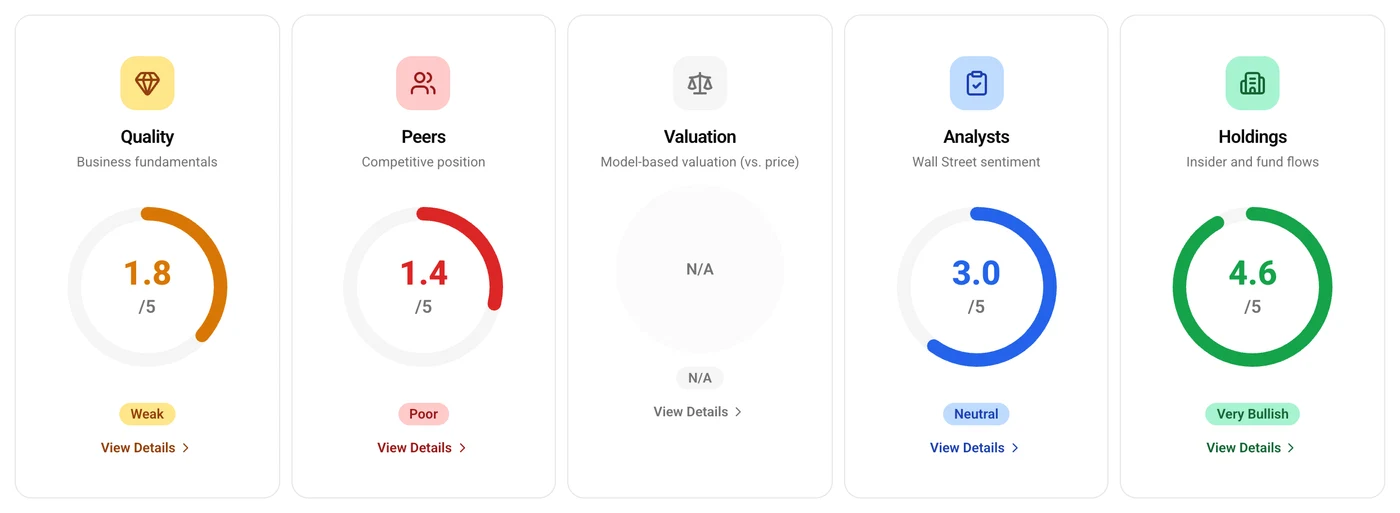
AST SpaceMobile is building satellites that connect straight to ordinary phones. It's a big idea, and Verizon has signed a commercial agreement.
Over the last year it made $115 million in sales and lost $599 million running the business. That's about $5 lost for every $1 it brought in, or about $4 if you leave out a $126 million write-off for a lost satellite. Its debt went from $0.5 billion to $3.0 billion in a year. It had $2.3 billion of cash and investments at June, and used $695 million in the June quarter alone. And at more than 130 times sales, the price assumes the plan works.
Analysts' targets have pointed to big upside for most of the year. The median target was $137 in March, with the stock at $89, and $106 in July, with the stock at $58. It's $78 now, against a price under $40. A target tells you where analysts think the price could go. It doesn't tell you what the business is earning.
What would change our mind: phone carriers paying it every month, and a clear path to a profit. Analysts don't expect one before 2028.
CoreWeave (CRWV)
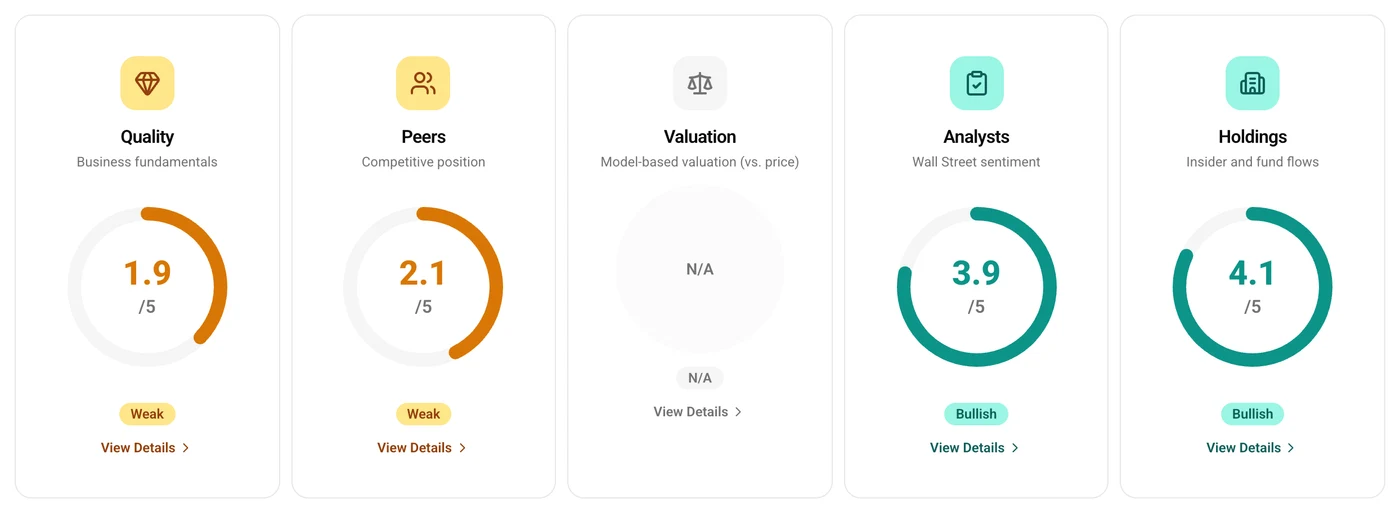
CoreWeave rents out AI computing power from data centres full of Nvidia chips. The demand is real: sales more than doubled in a year, and it has $104 billion of signed contracts still to deliver.
The problem is how it pays for the build. In the last year it spent $20.6 billion on data centres and chips, nearly three times its sales, and borrowed to cover the gap. Debt and leases went from $14.6 billion to $51.6 billion. The business itself is close to breaking even: in the June quarter it lost $49 million before interest. The interest on what it owes cost $640 million.
The $104 billion of contracts will pay out over years, while the interest is due every quarter. Some customers pay in advance, and that money went from $4.8 billion to $9.7 billion in the year to June, so customers funded about $5 billion of the $20.6 billion build. Borrowing carried most of it. Free cash flow has got worse every quarter since September 2025, from minus $0.7 billion to minus $5.7 billion.
You won't find a valuation score on CoreWeave's page right now, and that's deliberate. Our valuation compares each stock with similar companies and with its own history, and for CoreWeave those comparisons flatter it. On price to sales it looks cheap, because that measure ignores the debt. Counting the debt, it costs about 10 times sales, against about 7 for the typical tech company. Rather than show a score we don't trust, we've removed it while we work on a better method for companies like this.
What would change our mind: cash coming in faster than it goes out, and the debt starting to come down. Analysts don't expect a profit before 2028.
Cerebras (CBRS)
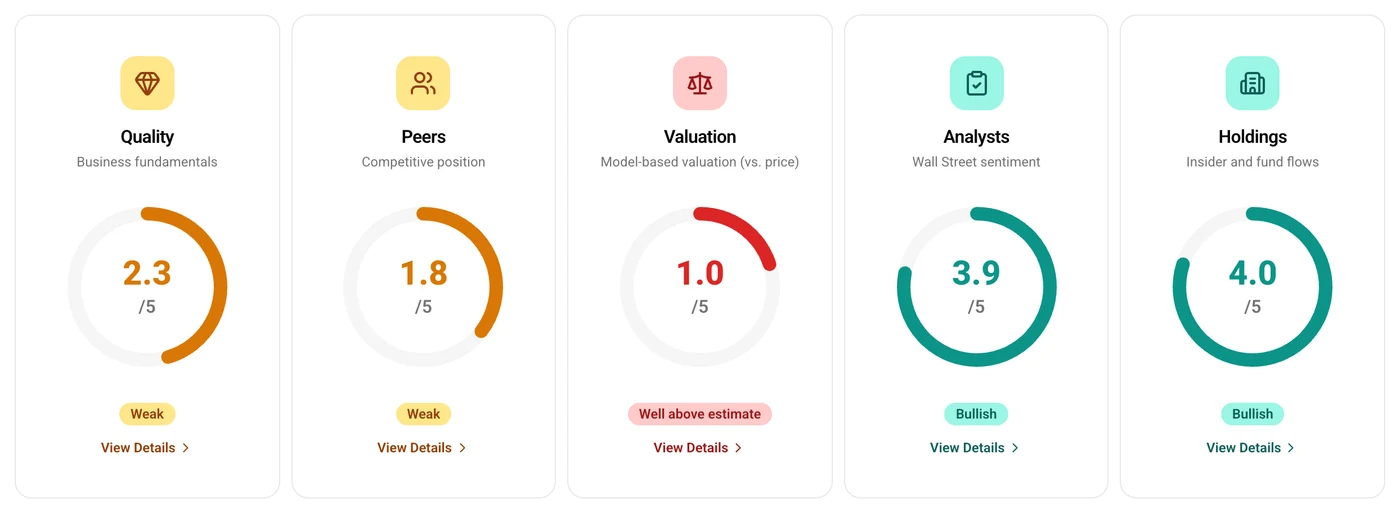
Cerebras makes very large chips built to run AI models fast. It has real strengths: about $8 billion in cash and investments, $25 billion of signed contracts and a deal with OpenAI.
The problem is how little we can see yet. It only listed in May, so there are just two quarterly reports as a public company. Two customers made up two thirds of its June-quarter sales, about a third each. And even after falling 64% from its first day of trading, to about 40% below its $185 listing price, it costs about 39 times its yearly sales. Cash isn't the issue, since it has far more cash than debt. What holds us back is the short history, the two customers and the price.
What would change our mind: a few more quarters of public numbers, more customers, and the profit analysts expect next year.
What we're not saying
We're not saying these are bad companies, or that their prices will keep falling. Some of them may well get there. Nebius's losses are shrinking fast as a share of sales, IREN has a large Microsoft contract, Rocket Lab's backlog keeps growing, and Cerebras has about $8 billion in cash and investments. If the profits show up, they'll show up in our scores, and we'll gladly post about them.
We try not to post hype. We post when the numbers back a stock, and these six never got there.
For the other side, the AI-related stocks that did pass our quality checks after this year's selloff, see 135 Chip and Hardware Stocks Are Down 25% or More. Seven Are High-Quality Businesses. Each of the six above has its own page on Stockoscope with all five scores: NBIS, IREN, RKLB, ASTS, CRWV and CBRS.
How we did it
- Post counts: X's full-archive count of posts naming any of the six cashtags from 19 October 2025 to 19 October 2026, each post counted once, with replies and reposts left out. The total was 1,693,707.
- Our own posts: searches of the Stockoscope account on X and of every post in our Reddit archive. Before this series began on 19 October, we made no posts about any of the six. On X we answered a few questions about some of them in replies.
- Prices: closes on 23 October 2026. The high is the highest close since 23 October 2025, so it can sit below the intraday high. For Cerebras, which listed on 14 May 2026, it's the first-day close.
- Financials: company filings up to the June 2026 quarter. Debt includes leases unless we say otherwise. CoreWeave's debt alone, as it reports it, went from $11.1 billion to $35.1 billion.
- Sales multiples: market value across all share classes, divided by the last four quarters of sales.
- Analyst targets: the weekly median target, as shown on each stock's Analysts tab.
- Scores: Stockoscope, as of 24 October 2026.
All data, prices and scores reflect information available at the time of writing (October 2026).
This analysis is for educational purposes only and does not constitute financial advice. Our scores and estimates are model outputs that move with their assumptions, and they do not account for your personal circumstances. Do your own research before making any investment decisions.